Algae Biofuel Market Size, Share, Demand Dynamics, and Future Outlook
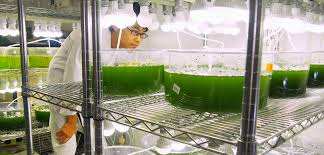
The Algae Biofuel Market stands at the forefront of sustainable energy innovation, promising to alleviate global dependence on fossil fuels while simultaneously addressing environmental concerns such as greenhouse gas emissions and energy security. Algae biofuel is derived from various species of microalgae and macroalgae, which are rich in lipids that can be converted into biodiesel, bioethanol, biogas, and other forms of renewable fuel. As global energy demands increase alongside stronger climate policies, the algae biofuel market is gaining traction among governments, research institutions, and commercial investors.
This comprehensive market research content explores the current landscape of the algae biofuel market, including industry dynamics, drivers, restraints, segmentation, regional outlook, competitive landscape, technological trends, and future growth prospects.
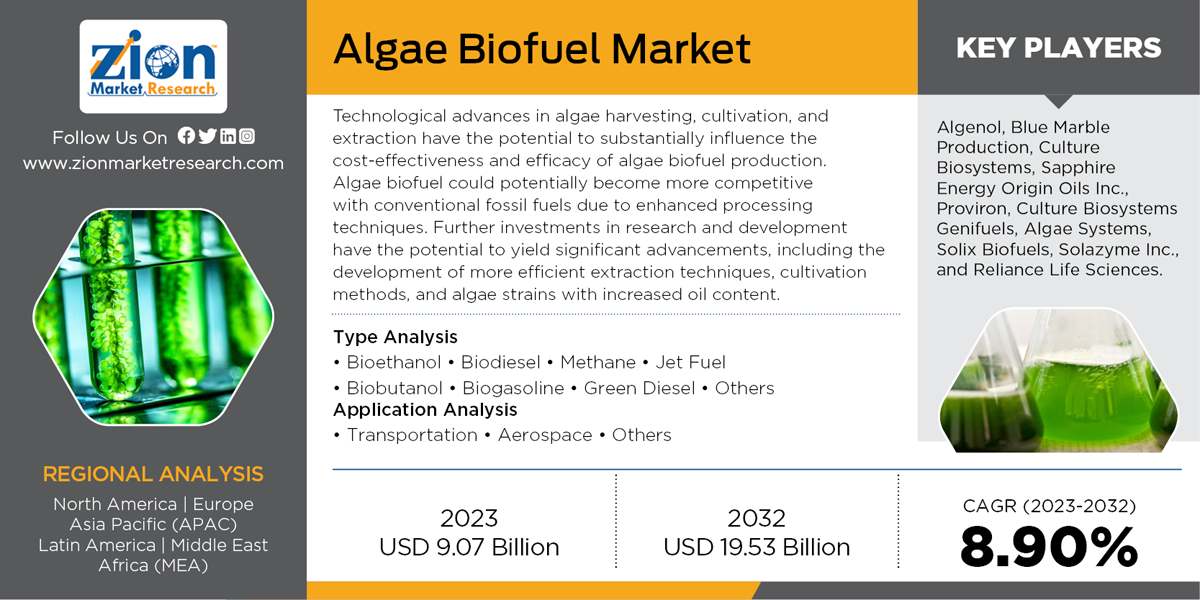
Market Overview
Algae biofuel represents a next-generation renewable energy source produced through the cultivation and processing of algal biomass. Unlike traditional biofuels derived from crops such as corn and soybean, algae have higher per-acre yields and do not compete directly with food crops for agricultural land. They can also grow in saline, wastewater, or non-arable land, making them an environmentally advantageous alternative.
The algae biofuel production process generally involves cultivating algae in open ponds or photobioreactors, harvesting the biomass, extracting lipids, and converting them through processes such as transesterification (for biodiesel) or fermentation (for bioethanol).
Market Size and Growth Outlook
The global algae biofuel market has witnessed significant developments in recent years. Although still in an emerging stage compared to conventional biofuels, the industry is projected to grow at a robust Compound Annual Growth Rate (CAGR) over the next decade. Growth is driven by increasing energy demand, stringent environmental regulations, and substantial investments in renewable technologies.
Governments worldwide are offering incentives, tax credits, and funding programs to encourage the adoption of sustainable fuels. Additionally, various pilot and commercial-scale algae biofuel projects have proven the technical feasibility of large-scale production, further bolstering market confidence.
Market Drivers
Rising Global Energy Demand
The world’s energy consumption continues to rise due to population growth, urbanization, and industrialization. Renewable energy sources such as algae biofuel help diversify energy portfolios and reduce dependence on depleting fossil fuels.
Environmental Sustainability
Algae biofuels significantly reduce greenhouse gas (GHG) emissions compared to fossil fuels. They can absorb CO₂ during growth and require less land and freshwater resources, supporting global climate change mitigation goals. This aligns with international commitments to reduce carbon footprints, including the Paris Agreement targets.
High Lipid Content and Yield Efficiency
Algae species possess high lipid content (up to 60% of dry weight in some strains), which directly influences biofuel yield. Algae’s rapid growth rates and high per-acre productivity make them an attractive feedstock for biofuel production.
Government Policies and Incentives
Many governments implement supportive policies such as renewable fuel standards, subsidies, tax incentives, and funding for research and development to accelerate biofuel adoption. These regulatory frameworks stimulate investments in algae biofuel projects.
Advancements in Technology
Technological innovations in algal cultivation systems, harvesting methods, and conversion processes (like hydrothermal liquefaction and anaerobic digestion) have improved production efficiency and cost-effectiveness.
Market Restraints
Despite promising growth, the algae biofuel market faces several challenges:
High Production Costs
One of the most significant barriers to commercialization is the high cost associated with algal cultivation, harvesting, and lipid extraction. Efficient and cost-effective technologies are still in development.
Technical Challenges
Scaling up production from laboratory or pilot levels to commercial volumes presents technical hurdles. These include contamination of algal cultures, energy-intensive processing steps, and maintaining optimal growth conditions.
Competition from Established Biofuels
Conventional biofuels such as ethanol and biodiesel derived from food crops or waste oils have matured markets and established supply chains, making it difficult for algae biofuel to compete on price.
Infrastructure Constraints
Insufficient infrastructure for distribution, storage, and blending limits market expansion, particularly in regions lacking robust renewable energy frameworks.
Market Segmentation
To understand the market dynamics comprehensively, the algae biofuel market can be segmented based on product type, technology, application, and end-user.
By Product Type
-
Biodiesel
-
Bioethanol
-
Biogas
-
Green Diesel
-
Biojet Fuel
Among these, biodiesel dominates due to its compatibility with existing diesel engines and blending mandates in several countries.
By Technology
-
Open Pond Systems
-
Photobioreactors (PBR)
-
Hybrid Systems
Photobioreactors offer higher productivity and controlled conditions, though at greater capital expenditure, whereas open ponds are more cost-effective but susceptible to contamination and environmental variability.
By Application
-
Transportation
-
Power Generation
-
Industrial Fuel
-
Aviation Fuel
Transportation remains the largest segment due to the demand for renewable automotive and aviation fuels. Biojet fuel, in particular, is gaining attention as the aviation industry seeks alternatives to reduce carbon emissions.
By End-User
-
Automotive Industry
-
Aerospace Sector
-
Energy & Utilities
-
Government & Defense
The automotive and aerospace sectors are key adopters as they strive to meet emission regulations and sustainability goals.
Regional Analysis
North America
North America is a prominent region in the algae biofuel market, supported by strong research infrastructure, government funding, and collaborations between universities and industry players. The United States, in particular, has numerous pilot projects and businesses focused on algae-based renewable fuels.
Europe
Europe is accelerating algae biofuel adoption through stringent environmental policies and renewable energy targets. Countries such as Germany, Spain, and the Netherlands are actively investing in algae cultivation technology and biofuel initiatives.
Asia-Pacific
The Asia-Pacific region is expected to witness rapid growth due to expanding energy needs, increasing investments in renewable energy, and supportive policies in countries such as China, India, and Japan. The region’s large population and industrial base create strong demand for sustainable fuel alternatives.
Latin America & Middle East & Africa
These regions are emerging markets with significant potential due to abundant sunlight, which benefits algae cultivation. However, limited infrastructure and investment challenges may slow immediate adoption.
Competitive Landscape
The algae biofuel market comprises a mix of startups, established energy companies, and research institutions working on commercialization strategies. Collaborations, joint ventures, and strategic partnerships are common as companies seek to pool resources, share technological expertise, and scale production capabilities.
Key strategies adopted by market players include:
-
Investment in R&D for cost reduction and process optimization
-
Strategic partnerships with government bodies and research organizations
-
Expansion of pilot projects to demonstration and commercial scales
-
Licensing of cultivation and conversion technologies
Prominent participants in the algae biofuel ecosystem continue to explore diverse algae strains, innovative cultivation systems, and integrated biorefinery concepts that produce not only biofuels but also high-value co-products such as animal feed, nutraceuticals, and bioplastics.
Key Trends and Opportunities
1. Integrated Biorefineries
The concept of integrated biorefineries, where algae biomass is used to produce fuels and other ancillary products, presents a promising avenue for enhancing economic viability and reducing waste.
2. Algae as a Carbon Capture Tool
Using algae to capture industrial CO₂ emissions from power plants or factories can simultaneously produce biofuel, offering a dual benefit in sustainability and emission control.
3. Aviation Sector Demand
With global pressure on the aviation industry to reduce carbon footprints, biojet fuel derived from algae is emerging as a strategic opportunity, supported by airline partnerships and pilot commercial flights using renewable fuels.
4. Genetic Engineering and Strain Optimization
Advancements in biotechnology allow for the development of high-lipid algae strains that improve yield and reduce production time — thereby enhancing profitability.
Future Outlook
The Algae Biofuel Market holds significant promise as part of the broader shift toward renewable energy and sustainable industrial practices. While commercialization challenges remain, continuous innovations in cultivation technology, cost-efficient processing, and supportive government policies will play a pivotal role in market growth.
As investments increase and more pilot projects transition to commercial-scale facilities, algae biofuel is poised to become a mainstream alternative to conventional fuels contributing to global energy security and environmental sustainability.
In conclusion, the algae biofuel market represents a dynamic intersection of technology, ecology, and economics. With its potential to revolutionize renewable energy landscapes and mitigate climate change, it attracts attention from stakeholders across industries and regions alike.
Other Report Zion Market Research:
https://www.zionmarketresearch.com/de/report/fine-fragrances-market
https://www.zionmarketresearch.com/de/report/heparin-market
https://www.zionmarketresearch.com/de/report/upstream-bioprocessing-market
https://www.zionmarketresearch.com/de/report/elispot-and-fluorospot-assay-market
https://www.zionmarketresearch.com/de/report/cell-based-assay-market

Related Posts

Oligonucleotide Synthesis Market: Comprehensive Market Research Analysis